
 by
by 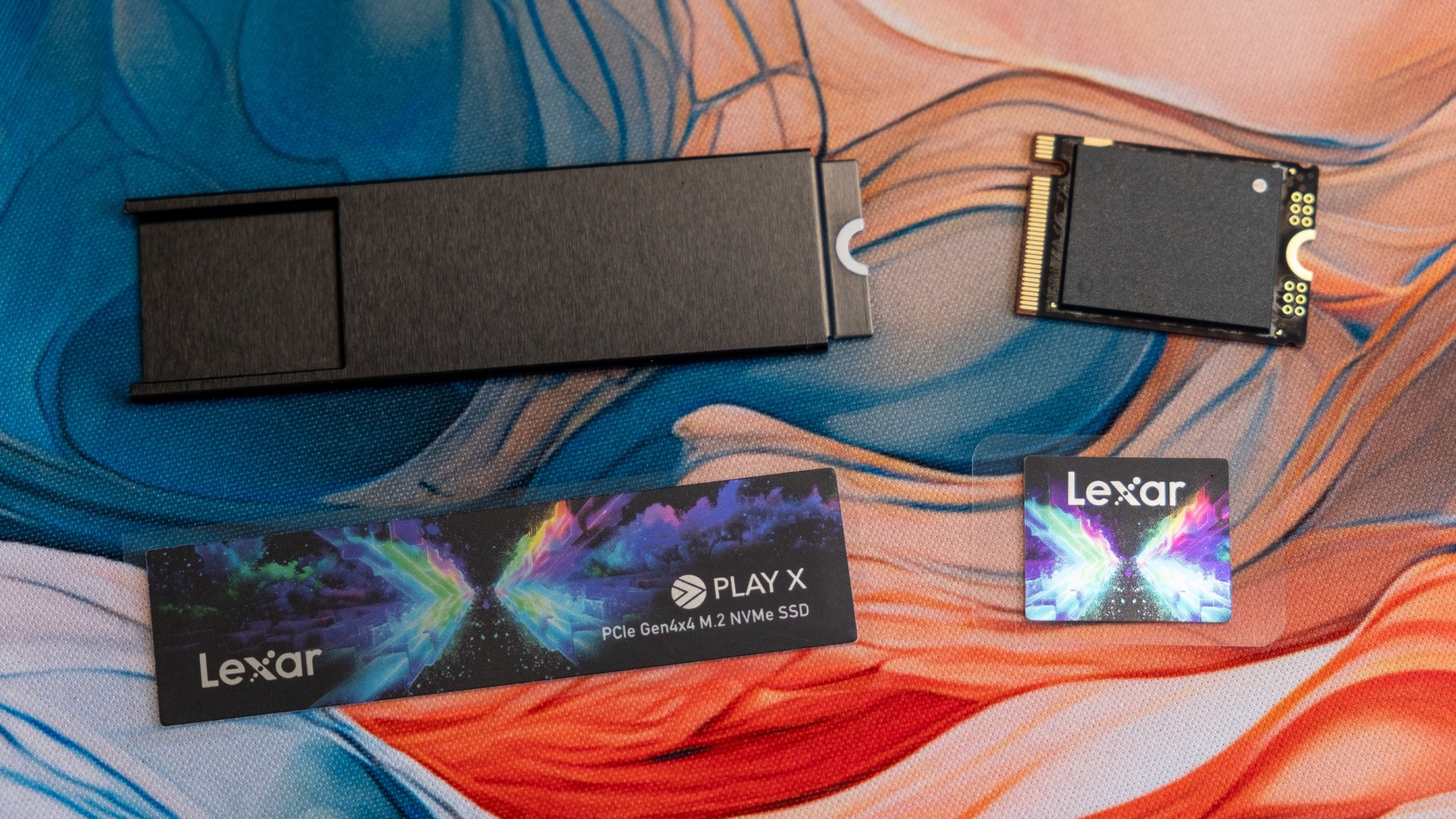
SSDs are expensive these days. There's no getting around that, so Chinese SSD maker Lexar has started to offer SSDs that can be adapted to multiple form factors - so a drive bought for one device can be used in a completely different one down the line. It's an interesting idea that brings us the Play X, a 2230 SSD designed for PC handhelds that can be adapted into a seamless 2280 size for full-size laptop and desktops instead.
Of course, 2230 to 2280 adapters are cheap - you can get one for less than a fiver on Amazon - so Lexar has focused on getting the implementation exactly right. The core module slots into the 2280 bracket with a definitive click, letting you know it's seated correctly, and the drive is completely unadorned out of the box. Instead, you can apply a 2230 or 2280 sized sticker from the options provided, giving you an SSD that looks visually coherent no matter which size you end up using. It's possible to remove those stickers and apply the other when changing sizes too.
Once your drive is installed, it all comes down to performance, and the Play X pushes the limits of the PCIe 4.0 interface in terms of its rated specs, thanks to the use of TLC NAND flash (rather than cheaper QLC) and the same Maxio MAP1602 controller as the excellent value Lexar NM790. Like that drive, there's an HMB cache instead of a DRAM cache, which is sensible for a single-sided 2230 drive where physical space is at a premium.
Its rated specs include a 7400MB/s max sequential read speed, a 6500MB/s max sequential write, and random read/write figures of up to 1000K IOPS. Those are higher than you'd expect for a single-sided 2230 SSD, which typically land more in the 5500MB/s to 7100MB/s range, and apply to the the largest 2TB capacity. The 1TB offers equal random speeds and 100MB/s slower max writes, and the 512GB model sees more noticeable cuts to sequential write speeds. As normal, endurance also varies by capacity, from 300TBW for 512GB to 600TBW for 1TB and 1200TBW for 2TB; these ratings match leading SSDs like the WD SN850x; a five-year warranty is also included.
In my synthetic benchmark testing on a Core i7 14700K + RTX 3090 system using an MSI Z690 Unify-X motherboard, our 1TB review unit got pretty close to its potential, recording 7095MB/s reads and 6580MB/s writes in CrystalDiskMark 9.0.3. Random performance was some way off however, at 283K IOPS reads and 234K IOPS writes at the 4K size.
We also tested with AS SSD and Atto Benchmark, with consistent results. In Atto, the Lexar Play X hits its stride at block sizes of 512KB, where it exceeds 6GB/s writes and 6.5GB/s reads, and that stays consistent up to the end of the test at 64MB block sizes. Meanwhile, AS SSD results in an overall score of 8592, with 3041 read and 4056 write scores - a little faster than first-gen PCIe 4.0 SSDs like the Sabrent Rocket 4.0 (~8100) but behind later-gen models like the Sabrent Rocket 4.0 Plus (~8900).
For more real-world tests, I opted for PCMark10's storage benchmark, which provides scores for various computing scenarios like booting the operating system, using content creation and office programs, and copying files to and from the drive. The overall score of 2847 puts the Play X just behind drives like the Crucial P5 Plus (~3100), WD Black SN770 (~3200) and just ahead of drives like the XPG Gammix S70 (~2700), Crucial P3 Plus (~2600) and Samsung 980 (~2500) - reasonable company for a drive of this physical size. There's relatively little extra information given from this test, save for a 448MB/s real-world bandwidth figure and a 58ms average access time, which again is consistent with mid-range PCIe 4.0 SSDs.
I also opted for the more gaming-focused 3DMark Storage Test, which uses traces from games like Overwatch, Black Ops 4, Battlefield 5, CS:GO. This one is interesting because, as well as doing the obvious load time tests, it also looks at performance while simultaneously recording via OBS, a common content creator scenario, and how long it takes to move games from an external drive to the SSD tested.
The Lexar Play X scored 3195 here, with particularly high scores for moving a game (2519MB/s) and loading Battlefield 5 (1042MB/s), allowing it to even exceed the (admittedly fuller) Crucial T705 this system uses as its primary drive, which scored 2774. Most of the game load tests were slightly faster on the T705, as you'd expect, but the Lexar drive scored 5x higher in the game move test to take around a 10 percent advantage in the final score.
I sanity-checked game load times with Red Dead Redemption 2, and got a 25-second load time on the Lexar Play X drive versus 30-second load time on a similarly expensive Kioxia Exceria Plus G3 SSD in the same system, so I have no complaints about real-world performance.
Ultimately, the Play X was more performant than I expected in both synthetic and real-world tests, and I'd be curious to see how those 3DMark and PCMark10 scores compare to your systems at home. The use of TLC and HBM is a potent combo, and for the mid-range prices that Lexar is asking, the well-designed convertible form factor of the drive feels like an interesting point of differentiation in what is a crowded and competitive market. However, ultimately price is the biggest factor when it comes to SSD purchases, and it's not worth paying for flexibility that you'll never use, so it makes sense to consider the Lexar Play X against other mid-range options from proven brands like Samsung, Crucial and WD.
The Lexar Play X is on sale now in the UK and a few other markets including Germany, France, Japan, Korea and New Zealand.
The Play X 1TB review unit was provided by Lexar.