
 by
by Remarkably, today's coverage of the AMD Radeon RX 9070 GRE is our first video card review of 2026. The AI semiconductor crisis has essentially left PC graphic hardware in stasis with no new releases - until now. Well, strictly speaking the RX 9070 GRE isn't new either, it's been available in China for quite some time, but releasing it now in the west is a good move. We've established that 8GB GPUs don't quite cut the mustard now for today's triple-A releases, while 16GB is arguably too lavish. By offering a 12GB part, AMD can reach a sweetspot for gamers - if the price is right. Unfortunately, it isn't.
In the US, AMD is suggesting $550 for the 9070 GRE in a world where you can pick up a full-fat RX 9070 for just $50 more. That's a small price to pay for four extra gigs and significantly more gaming performance. AMD seems to be targeting the obscenely expensive RTX 5060 Ti 16GB here, instead of comparing GRE pricing with its own products. The end result is a card that really requires a pricing adjustment. The remarkable truth is that during a memory crisis, AMD's 16GB RX 9070 actually offers better value than the new cut-back 12GB offering.
Let's take a quick look at GRE specs up against the rest of the RDNA 4 line up. It's based on the same Navi 48 processor, but has been pruned in terms of shaders - a circa 14 percent drop compared to the 9070 non-XT, 25 percent fewer shaders than the XT. Clock speeds on the GRE slot between the two, but the other major cutback comes from the memory interface. The 256-bit bus on the other cards drops down to 192-bit, memory speed is pruned back from 20Gbps to 18Gbps. Memory bandwidth therefore drops from 640GB/s down to 432GB/s. That's a lot of hardware you're missing for a mere $50 saving.
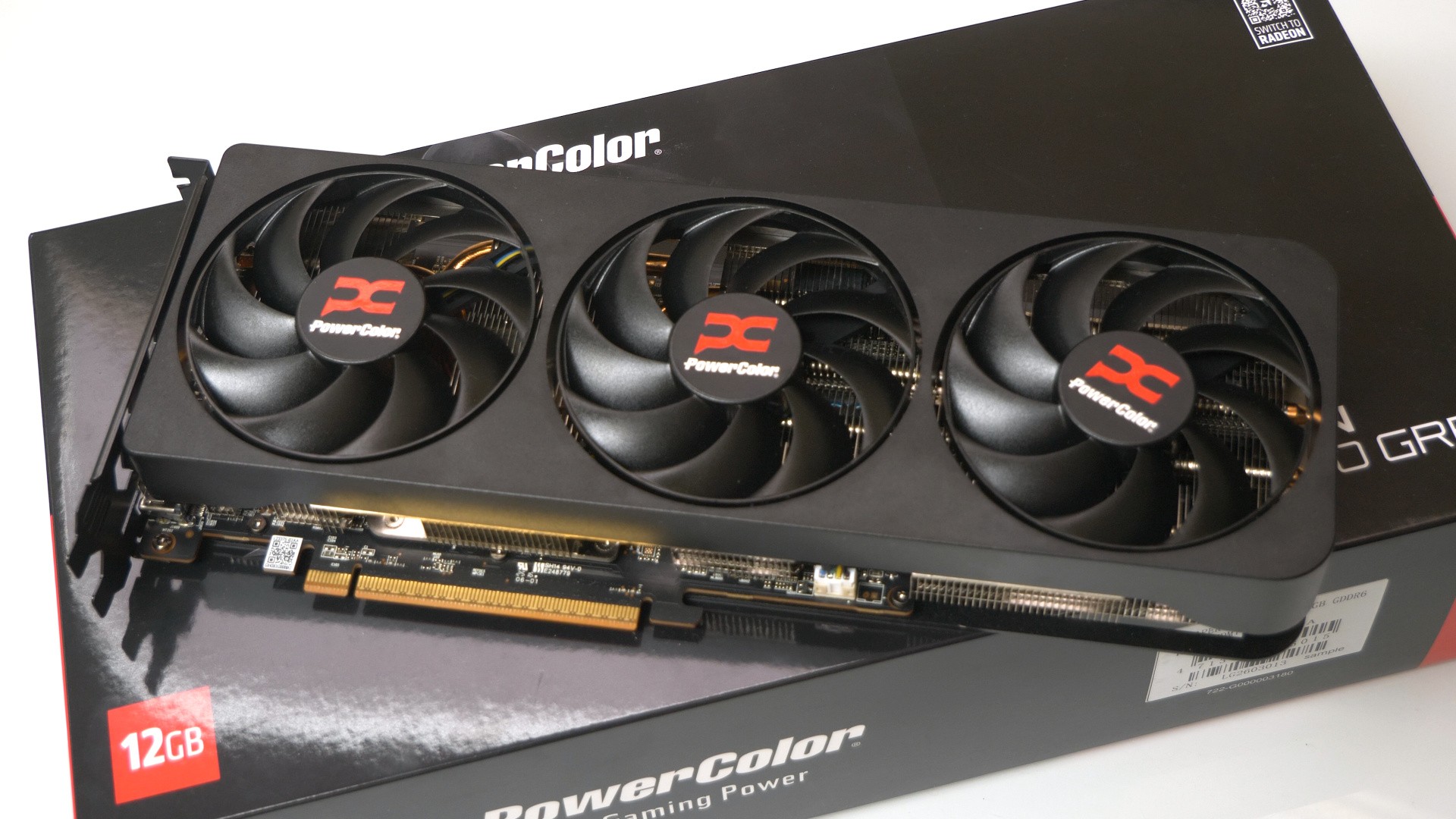
The card we received for review courtesy of AMD is the PowerColor Reaper model and I've had no issues with it whatsoever. It's a triple-fan design with barely perceptible fan noise and doesn't go crazy on RGB lighting or other extraneous features. Power is delivered via two eight-pin PCIe inputs, with three DisplayPort 2.1a outputs and an HDMI 2.1b port. Particularly when cost is an issue, a basic card that gets the fundamentals right is key and this fits the bill.
|
RX 9070 GRE |
RX 9070 |
RX 9070 XT |
|
|
Shaders |
3072 |
3584 |
4096 |
|
Boost clock |
2.79GHz |
2.52GHz |
2.97GHz |
|
Memory |
12GB GDDR6 |
16GB GDDR6 |
16GB GDDR6 |
|
Mem Interface |
192-bit |
256-bit |
256-bit |
|
Mem Speed |
18Gbps |
20Gbps |
20Gbps |
|
Mem Bandwidth |
432GB/s |
640GB/s |
640GB/s |
|
Board Power |
220W |
220W |
304W |
I'm going to save the blow-by-blow benchmark results for the video embedded above and there's a table below with an at-a-glance look at how performance and value combine to paint a poor picture for the RX 9070 GRE. Take a look specifically at the "dollars per frame" metric and then compare the percentage differentials on price and performance.
It's clear that the Nvidia cards are commanding higher prices (based on lowest NewEgg numbers) with the RTX 5060 Ti 16GB in particular demonstrating excessively poor value, putting it at the very bottom of the table. The RX 9060 XT 16GB offers more value, but at a $450 price, I don't think the performance is justified. What's remarkable is that based on our numbers, the value proposition offered by the RX 9070 GRE and the RTX 5070 is very, very similar. This is a red flag on GRE pricing.
However, the relative value of the RX 9070 and even the top-end RX 9070 XT is higher than the GRE and from my perspective, this simply doesn't make sense. Is the RX 9070 about to be discontinued (AMD had no answers for me when I asked). Is GRE pricing influenced by the over-priced RX 9060 XT? It doesn't really matter: the fact remains that right now, $50 more buys you an average 20 percent more performance and an extra four gigs of VRAM.
|
Value Ranking (1440p) |
Average FPS |
US Pricing |
Dollars Per Frame |
|
1. RX 9070 |
69.19 (120%) |
$600 (109%) |
8.67 |
|
2. RX 9070 XT |
78.87 (137%) |
$700 (127%) |
8.88 |
|
3. RTX 5070 |
66.41 (115%) |
$629 (114%) |
9.47 |
|
4. RX 9070 GRE |
57.61 (100%) |
$550 (100%) |
9.55 |
|
5. RX 9060 XT 16GB |
44.24 (77%) |
$450 (82%) |
10.17 |
|
6. RTX 5060 Ti 16GB |
48.08 (84%) |
$570 (104%) |
11.86 |
I should add the caveat that you will get different numbers testing different games, so as ever, I would recommend looking at GPU reviews from a wider range of trusted outlets - but let's put it this way. I was expecting more from the RX 9070 GRE to the point where I thought there was something wrong with my card - and I actually re-tested both GRE and standard 9070 several times after using DDU to wipe all the drivers and then to install them anew.
I then tested a bunch of more modern games using optimised settings and FSR 4 balanced mode upscaling to 1440p. The percentage differentials close up a touch (upscaling does that) but the fact remains that the RX 9070 still offers better value. Meanwhile, RTX 5070 offers choices to players that AMD currently can't deliver: path tracing and DLSS multi-frame generation. And yes, PT does work on a 70-class card - you just need to be realistic with your settings selections: accept 1440p output resolution and DLSS balanced mode or performance mode, depending on the title.
This extra testing was instructional, however. Actually playing games with the RX 9070 GRE is a treat, delivering excellent visuals and impressive performance. Certainly the days of Nvidia always beating AMD in ray tracing are a thing of the past - the GRE may be slower than the 9070 and the 5070, but that doesn't make its level of performance poor. Therefore this is a product worth buying, but only when the price vs performance ratio makes sense. A price of around $500 makes the maths work. However, there is less memory in the GRE product, while users should expect more value from lower priced cards - it should be cheaper still. Bottom line: the RX 9070 GRE has plenty of plus points but it looks like it'll require the market to do its thing in finding the natural price-point for this card.


Comments 1
Looks an OK card if the price is right. But if its to close to the 9070 xt well I know what most would buy.
Thanks for the article Rich
Show Comments
Leave A Comment
Hold on there, you need to login to post a comment...