
 by
by 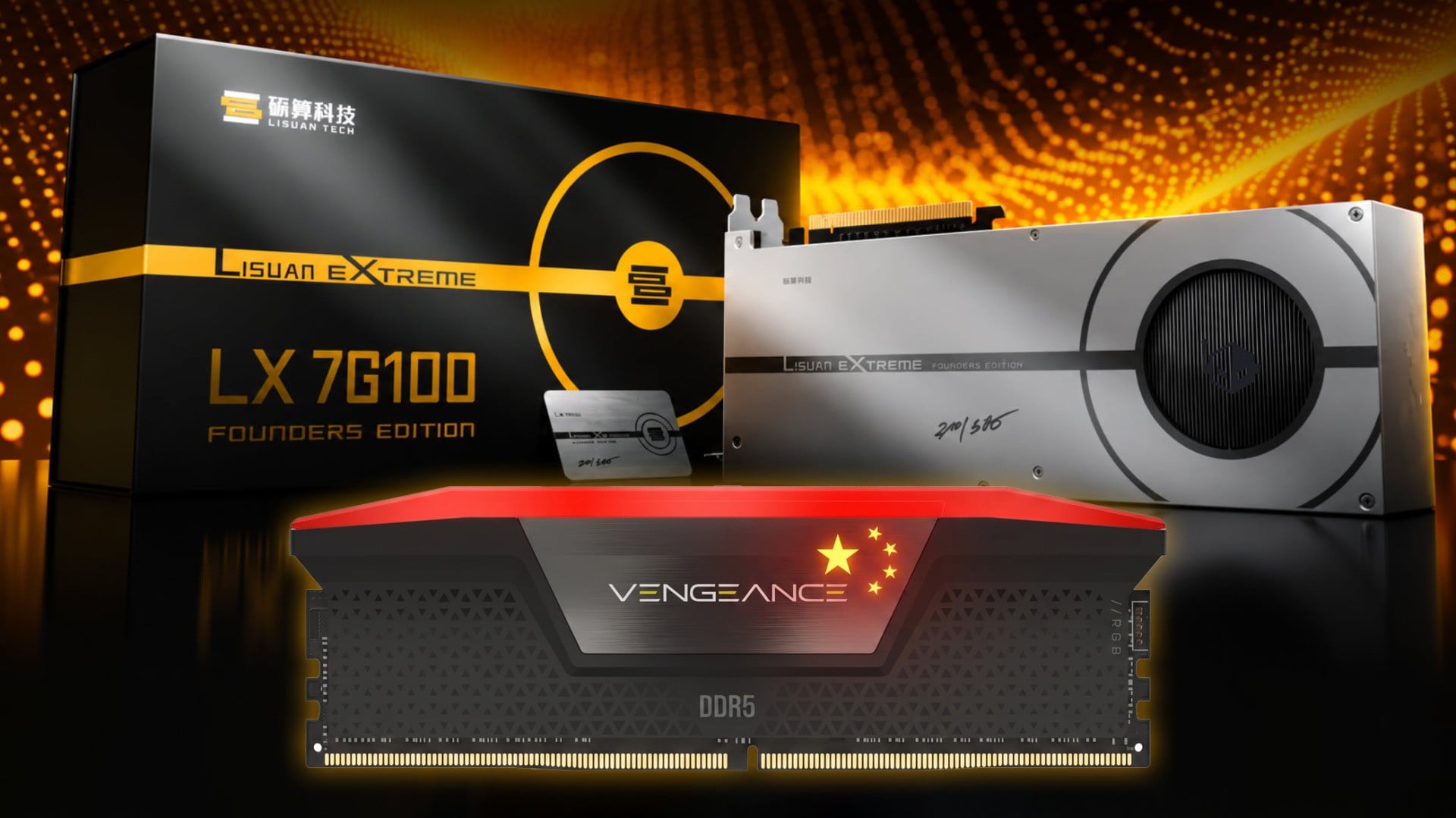
Just like China's EV market, the country's domestic electronics space is in something of a boom period - with even more R&D-dependent categories like flash memory and graphics cards becoming increasingly competitive with what's available from more established brands outside of mainland China. Two big thresholds were passed this week, as Corsair started to tap Chinese-made DDR5 for its DRAM modules, while GPU maker Lisuan produced its first DX12 compatible graphics card.
Let's look at the RAM news first. Unsurprisingly, with the flash memory output of producers in Taiwan, South Korea and Japan being exhausted in the current AI surge, Chinese manufacturers CXMT and YMTC are stepping up as alternative options. Corsair is the first Western RAM maker we know of that's opted for CXMT dies in their products, with leaker @wxnod posting images of a 16GB Vengeance DDR5-6000 CL36 stick running in Aida64, Hwinfo64 and CPU-Z.
Normally, Corsair uses the likes of Samsung, SK Hynix or Micron, so this is a fairly notable change. Testing by Hardware Unboxed of other Chinese DDR5 revealed equivalent performance to better-known alternatives, so if these suppliers can be more aggressive on price, we could see wider adoption in the future. CXMT is currently working on higher-speed kits up to 8000MT/s, with 16GB and 24GB modules across a variety of form factors, which should work nicely with future AMD and Intel chipsets.
Developing 100 percent home-grown graphics cards is even more research-intensive, and China's domestic scene is still some way away from rivalling the likes of Nvidia, Intel or AMD given their decades-long head start in terms of silicon production and particularly driver optimisation. Still, even making a modern DX12-compatible graphics card is a milestone, and that's what Lisuan seems to have accomplished with their LX 7G100 Founders Edition model.
Testing by Chinese channel Chaowanke shows the Lisuan GPU trailing the Arc B580, RTX 3060 and RX 6600 XT by a huge margin, but it can at least run a selection of modern games at somewhat playable frame-rates. The 7G100 turns in a 71fps average in Shadow of the Tomb Raider at 1080p for example, versus 159fps for the RX 6600 XT. Other titles are less competitive, with the 7G100 only managing a 48fps average in Forza Horizon 5 with a punishing 18fps one-percent low, versus 228fps average and a low of 189fps for the second-worst-performing RTX 4060. Forza Horizon 6 blocks the GPU entirely with an error screen on boot, so it's certainly a spectrum when it comes to performance.
The full video is interesting to watch (and is available with a perfectly cromulent English dub), so I recommend giving it a look to get an idea of where the Chinese GPU industry is at right now. I don't think Lisuan or other Chinese competitors be challenging the big three in the next generation or two, but it might happen sooner than you think.
After all, the rise in Chinese EVs in the UK (and worldwide!) makes it clear that the country is willing to invest incredible sums of money into its domestic industries - and computer hardware is definitely on that priority list. Visiting China earlier this year to see how consumer flash memory products are produced was an eye-opening experience when it comes to scale and scope, and that was only a visit to a single company.
What do you make of the news? Would you buy a Chinese RAM stick or graphics card in the future? Let us know in the comments below.