
 by
by Path tracing is the most demanding form of ray tracing you can do, normally requiring an extremely high-end PC graphics card and low input resolutions to produce playable frame-rates. However, we learned this week that developers at Codemasters were able to get a path-traced prototype version of F1 25 running on PS5 Pro, a monumental achievement given the level of performance available even on the fastest current-gen console.
The news comes from a GDC 2026 presentation called "Path Tracing at 200mph" (currently paywalled on the GDC Vault) that focused primarily on the PC version, detailing the efforts of two senior engine programmers who worked on the project over the course of a full year. Right at the end of the presentation, it's noted that the RX 9070 XT is surprisingly OK at path tracing in their testing - delivering a solid 30fps update rate during a night race at Abu Dhabi at 4K using FSR3 quality mode. The results got them thinking about even less powerful graphics hardware.
Cue the surprise delivery of a video of F1 25 running with path tracing on the PS5 Pro. This particular version runs with an internal resolution of 1080p, somewhat little below the 1440p used on the RX 9070 XT, but upscaled to 4K using PSSR. While a naïve port from the PC version reportedly ran with frame-times around 42.32ms, equivalent to a frame-rate of circa 24fps, a more advanced path tracing prototype called "ORCA" from the EA Seed internal research organisation was capable of much better results: 23.36ms on average, or around 43fps. That potentially offers the headroom for a consistent 30fps output on Pro.
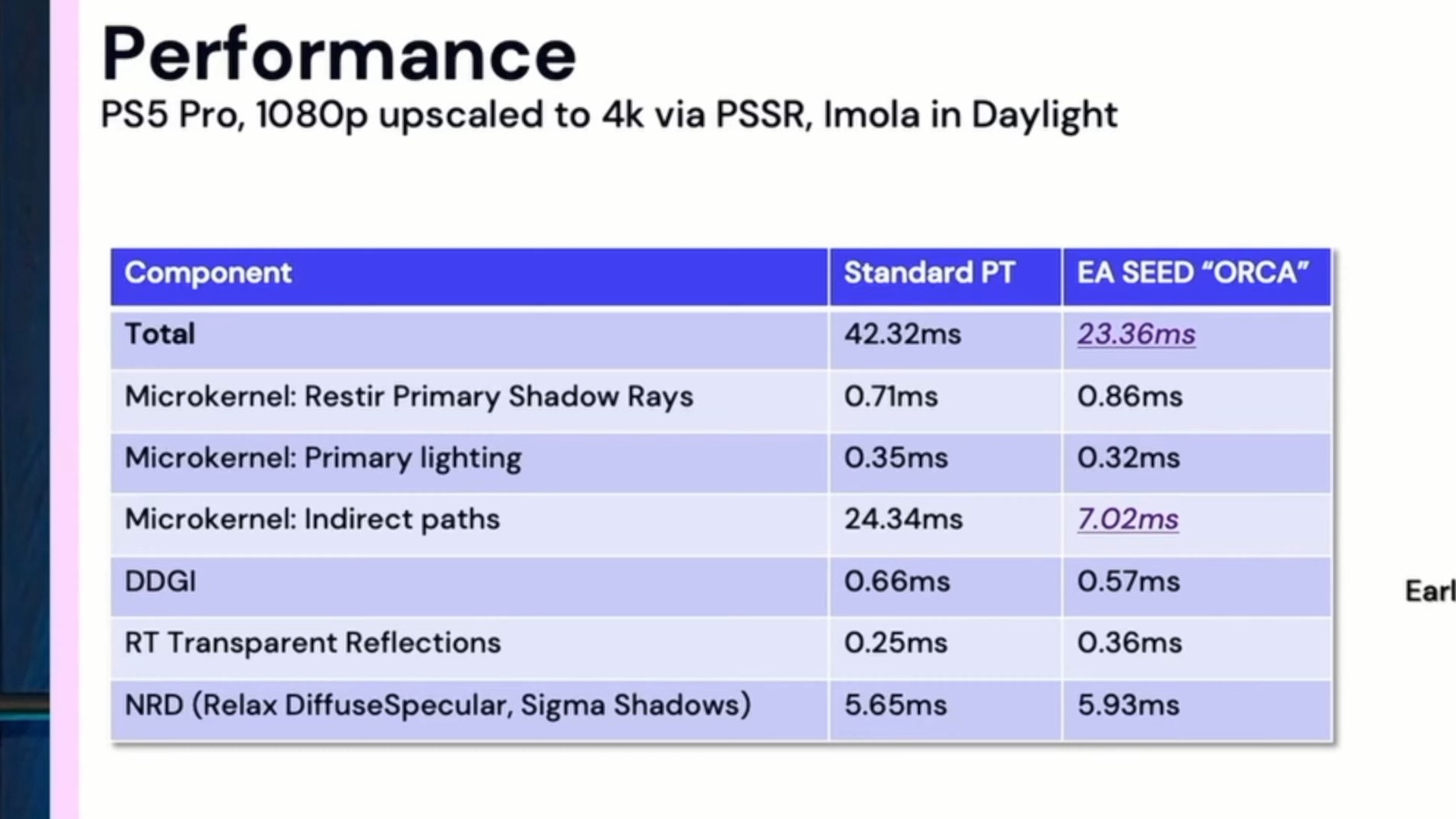
The one big proviso here is these performance figures are based on testing in the daytime at Imola, which is much less demanding than a night track like Abu Dhabi or a wet track like Silverstone (most years), as the numerous dynamic light sources in these scenarios significantly increases the computational cost. In this week's DF Direct, there's a degree of hope that Codemasters will ship the technology - and perhaps lower rendering resolutions might help in a world where even native 864p can look good on Pro titles.
Still, it's a remarkable achievement, even in prototype form, and the techniques used here could be applicable in other games. For example, the F1 25 prototype eschews the complex radiance caches of most path-traced titles, instead using DDGI (dynamic diffuse global illumination) for secondary light bounces. This provides a more stable lighting structure that comes in handy given the high-speed nature of gameplay.
While it's clear from context that this is a research project rather than anything expected to come to the shipping game on any system, the existence of a working prototype at least suggests that path tracing on PS5 Pro (and future next-gen consoles) is more viable than perhaps we imagined. And PS5 architect Mark Cerny is thanked at the end of the presentation, so perhaps a special PS5 Pro release of a path-traced F1 game isn't an impossibility in the future!


Comments 3
They’ve taken a year off to make F1 27 (2026 is DLC), wonder what other improvements will appear. Even the “standard” version of F1 25 on the PS5 Amateur looks and runs fantastic, fingers crossed we don’t lose that!
It’s great to see Codies still pushing technical boundaries, given all the cuts and limitations placed on them in recent years. Well done!
Fsr 3, is this a typo? FSR 4 surely on a 9070xt? Why would the developers choose not to engage the driver side auto upgrade to FSR4 for Path Tracing on F1 2025?
Show Comments
Leave A Comment
Hold on there, you need to login to post a comment...