
 by
by 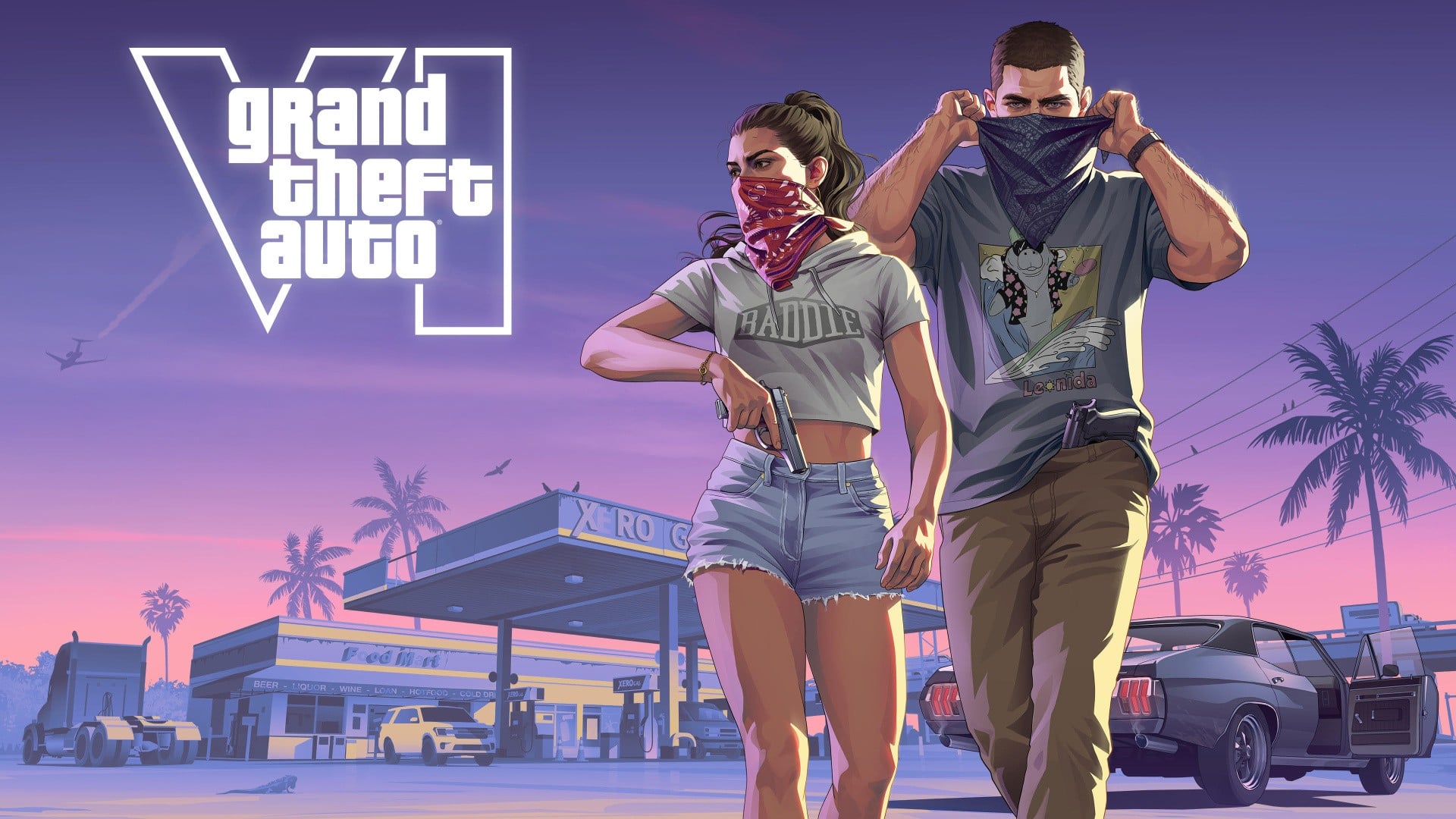
The first extended look at the gameplay of Grand Theft Auto 6 hit the internet last night and we're currently editing a DF Direct Special where Oliver and Rich discuss their thoughts at length in an 80 minute video. Rich describes the scale of the technological achievement as singular across the entire console generation - gaming's equivalent to the Apollo space programme - while Oliver believes it's the most impressive example of real-time game rendering he's even seen.
But first of all, there is seemingly clarity on the game's target performance level. The footage supplied to Netflix and YouTube, also available on the Rockstar site itself, is a 30 frames per second video asset. There are numerous reasons why this is a bad idea (your console outputs at 60fps, and only if performance is a perfect, locked 30fps will the video be representative) but the bottom line is that the developer deemed this sufficient as the game itself targets 30fps - and seemingly, that's now 100 percent confirmed.
According to reports from those speaking to Rockstar, the developers have stated that higher frame-rate modes will be considered for post-launch updates, but it's clear that the focus was absolutely maximising the level of visual detail at a fixed 30fps frame-rate on all platforms. The rendering, simulation and presentation have all been tuned around that constraint - and the result is an unprecedented level of density, material quality and world coherence, with trade-offs landing primarily in image quality and animation smoothness rather than systemic scale or fidelity.
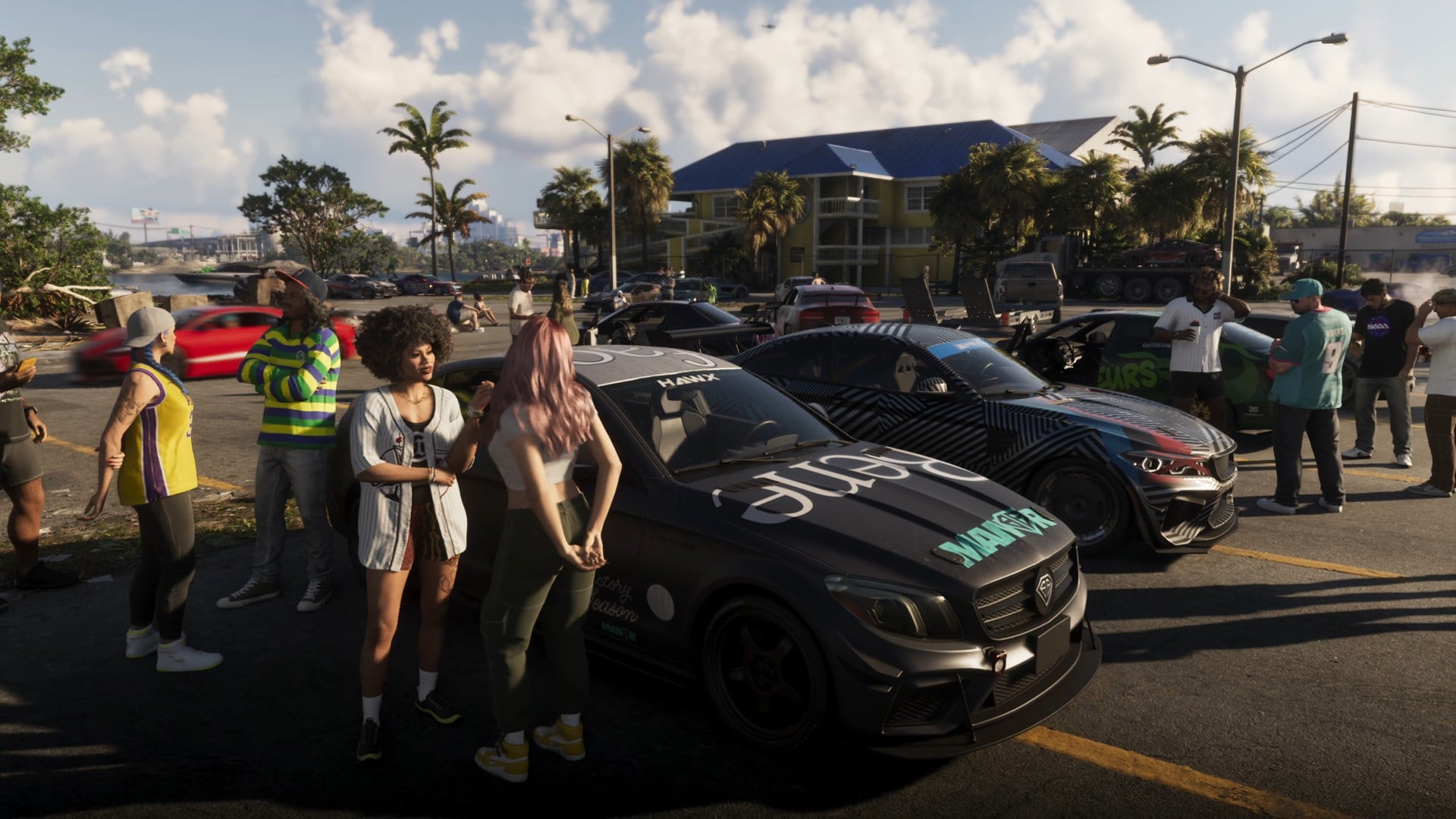
Character rendering is perhaps the most standout visual feature here, with huge generational improvements to hair simulation and shading, which extends to straight, wavy and curly hair, complete with proper light transport and secondary motion. Lucia's hair behaves realistically in both cutscenes and gameplay, with base-to-tip motion, delayed follow-through and convincing snap-back motions that you don't often see in video game hair. Skin shading is also on another level, with a semi-stylised aesthetic. Specular highlights track realistically, sweat and make-up look true-to-life, and bodies in hot, humid spaces look slick in a way that real-time rendering rarely portrays. This level of fidelity is rare to see in cutscenes, and much more so in gameplay as the Extended Look trailer shows.
Underpinning the presentation is Rockstar's continued evolution of its in-house rendering stack, continuing the shift to ray-traced effects seen in GTA 5 Enhanced Edition. Sun and most local shadows appear to remain based on highly refined shadow maps, with visible but subdued aliasing in some close-up cases. Variable penumbra behaviour - tighter near the caster, softer with distance - is present and considerably improved over earlier showings of the game. In certain close-to-the-face shots, shadow fidelity rises to the point where limited, cutscene-specific RT shadows may be in play, but if so they are deployed surgically rather than as a blanket solution. The overall takeaway is that Rockstar has invested heavily in maturing its shadow map technology rather than leaning exclusively on hardware RT for this aspect of the image.
Ray tracing, however, is clearly central to the game's lighting and reflections. Specular reflections are widely deployed across opaque and transparent surfaces, with skinned meshes - including characters - visible in reflections even when screen-space data would not suffice. This strongly indicates a robust RT reflections solution, augmented by selective use of screen-space information for efficiency. The reflections resolve plausible distant geometry and lighting, but inherit familiar generational compromises: low internal resolution, blur and ghosting under camera motion, with a cleaner, higher-detail look when the camera rests. Interestingly, certain elements such as household mirrors still appear to use planar reflections, consistent with previous Rockstar titles. Where an older technique remains visually superior or cheaper for a specific case, the developers are happy to keep it in the toolbox.
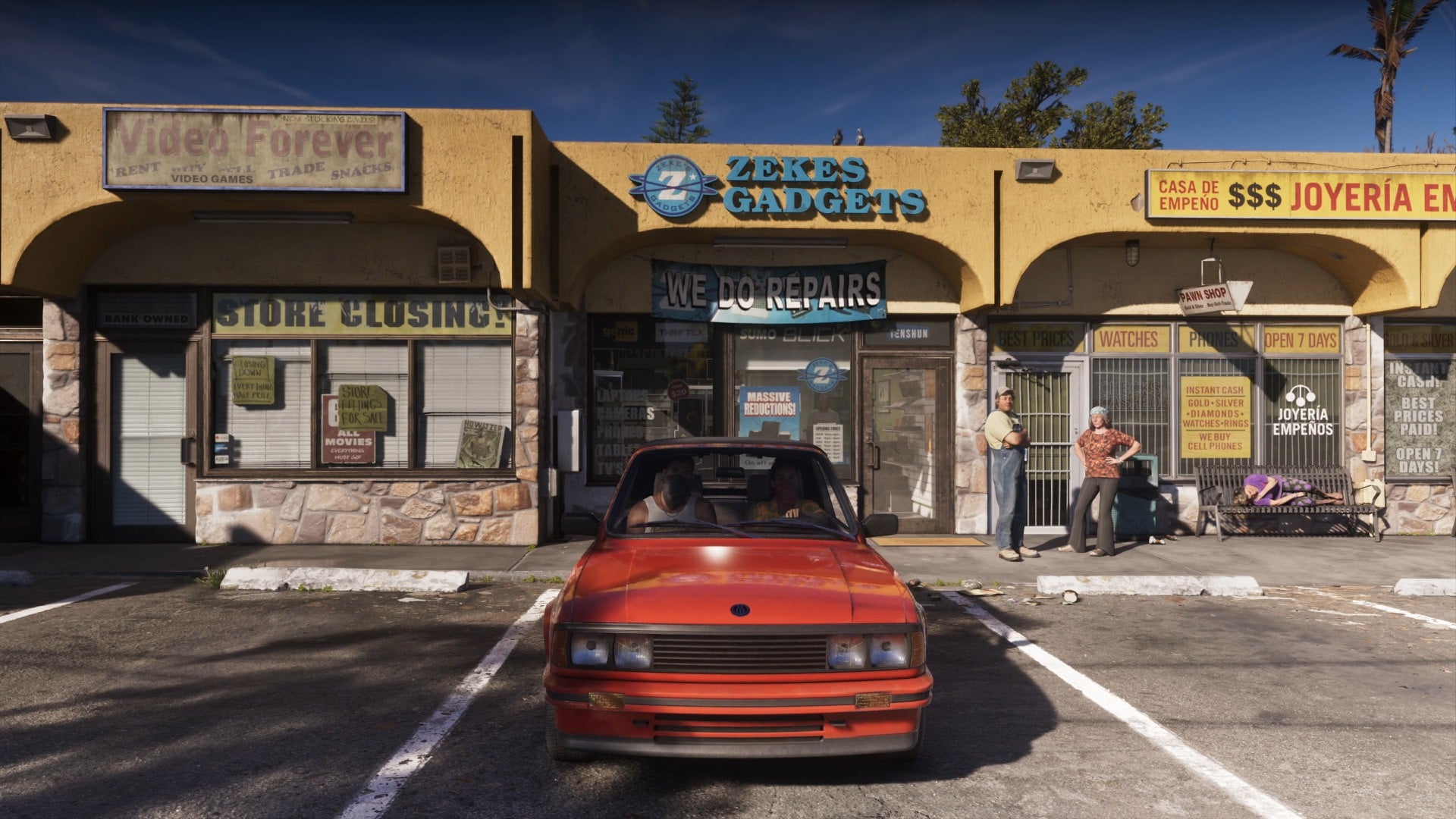
Diffuse global illumination is also heavily ray-traced, and this is arguably where RT is most indispensable. The city's interiors and exteriors are lit with indirect bounces that respect occlusion, colour bleeding and complex geometry in ways that would be near-impossible to achieve robustly with baked probes in a world this dense and dynamic. Subtle effects, like coloured light transmission through transparent objects and character bodies feeding light back into nearby surfaces, are evident. At the same time, characteristic RT noise and stochastic breakup are visible in certain shots. The GI solution looks performant and world-class, but it is still subject to the temporal compromises needed to make it work on console hardware.
Beneath the rendering, simulation scale and complexity are a key differentiator. Even in largely mission-driven footage, there are clear hints of an unusually sophisticated NPC ecosystem: large crowds in clubs and on beaches, numerous vehicles, and a suggestion of higher per-character agency than in prior open world games. Rockstar appears to be targeting not only high counts of NPCs and cars, but believable pathfinding, varied reactions and persistence as entities move in and out of the player's vicinity. Rigid body physics, destructible props and environmental detail also look rich. That said, the trailer's curated nature means the true extent of emergent systemic behaviour - like how crowds react when chaos breaks out, how far persistence and simulation reach - remains unproven.
The internal rendering resolution on PS5 looks like 1440p, without DRS - at least in this trailer. However, the output does not cohere into a sharp 4K presentation, and there is no strong evidence of modern temporal upscalers such as FSR 2 or TAA upscaling being used. Instead, the image reads very much like a relatively straightforward spatial upscale from 1440p to 4K, bringing with it a degree of softness, visible geometric aliasing and shimmer on fine details. RT elements exacerbate this in places, with noisy, smeared reflections that can look worse than older screen-space solutions in some static comparisons.
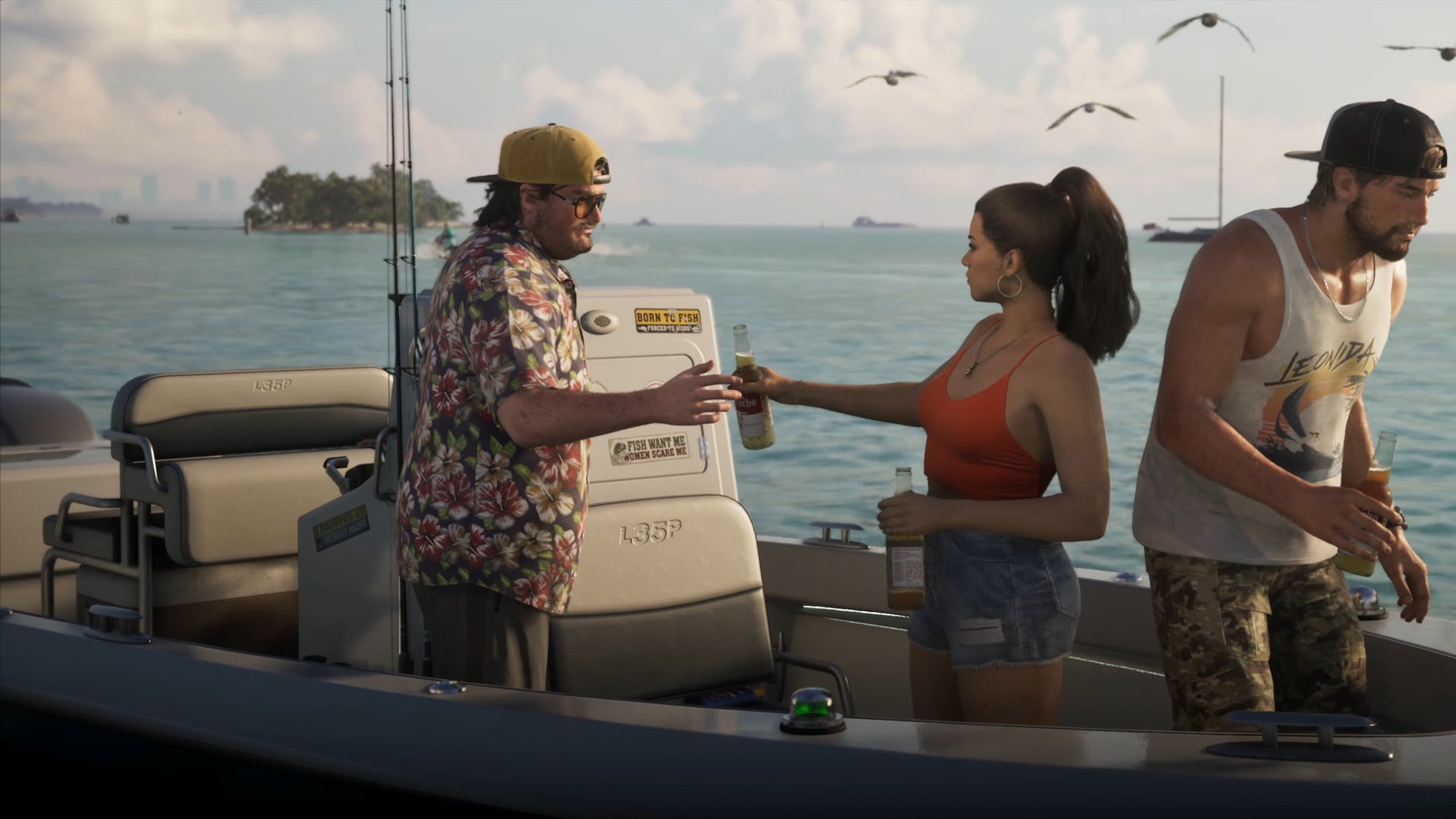
Returning again to performance, the gameplay shown is a relatively stable and well-paced 30fps output, with only very occasional single frame drops (though the nature of the 30fps asset means there could be more, unseen). There's no sign, for instance, of the kind of aggressive frame-rate drops that characterised the Xbox 360 and PS3 launches of GTA 4 and GTA 5. Instead, the evidence suggests that the game maintains its 33.3ms cadence with care, and Rockstar has clearly spent immense effort balancing CPU and GPU workloads to fully saturate the hardware. That makes a 60fps version extremely unlikely on console hardware - there's no way to regain enough GPU and particularly CPU time to make a 16.7ms update rate work without compromising the world.
Within that solid 30fps frame delivery, there's still a persistent animation and camera pacing issue that ranks as a long-standing quirk of Rockstar's Rage engine. Even at stable frame-rates, character animation and camera pans can exhibit uneven motion. Some frames show larger jumps in position than others, producing a subtle but pervasive stutter or judder that can make the presentation feel lower than its actual frame-rate in both gameplay and cutscene sections. This may stem from a fundamental timing or synchronisation mismatch between animation and frame updates, and it seems unlikely to be resolved for launch given its long history in Rockstar projects.
Looking ahead to other console versions and the presumably-coming-eventually PC release, some level of caution is required. The PC platform ought to allow for higher resolutions, especially with the benefit of more modern temporal upscalers like DLSS, alongside increased RT sample counts, longer draw distances and so on. However, the CPU demands of a world this complex - tuned around console Zen 2 cores at 30fps - could make hitting 60fps genuinely challenging in a way we don't often see, and will likely require a high-end CPU like a recent Ryzen X3D to avoid bottlenecks.

The Extended Look footage was captured on a base PS5, so we should expect the game to look a little better on PS5 Pro, which has a more powerful GPU with PSSR upscaling available. That extra horsepower ought to translate into higher-quality RT effects and improved image quality, but we'll have to wait until Sony or Rockstar show PS5 Pro footage to get an idea of precisely where the Pro version of the game will land. The same goes for next-gen consoles, though these are still years away.
In any case, the Extended Look has been a fascinating reveal of this generation's most hotly anticipated game, and we're looking forward to learning more about the specifics of the different console versions and perhaps seeing more gameplay in the run-up to launch.
What did you make of the trailer? Do you have any unresolved questions? Let us know in the comments below.